The Significance of the Greenland Map
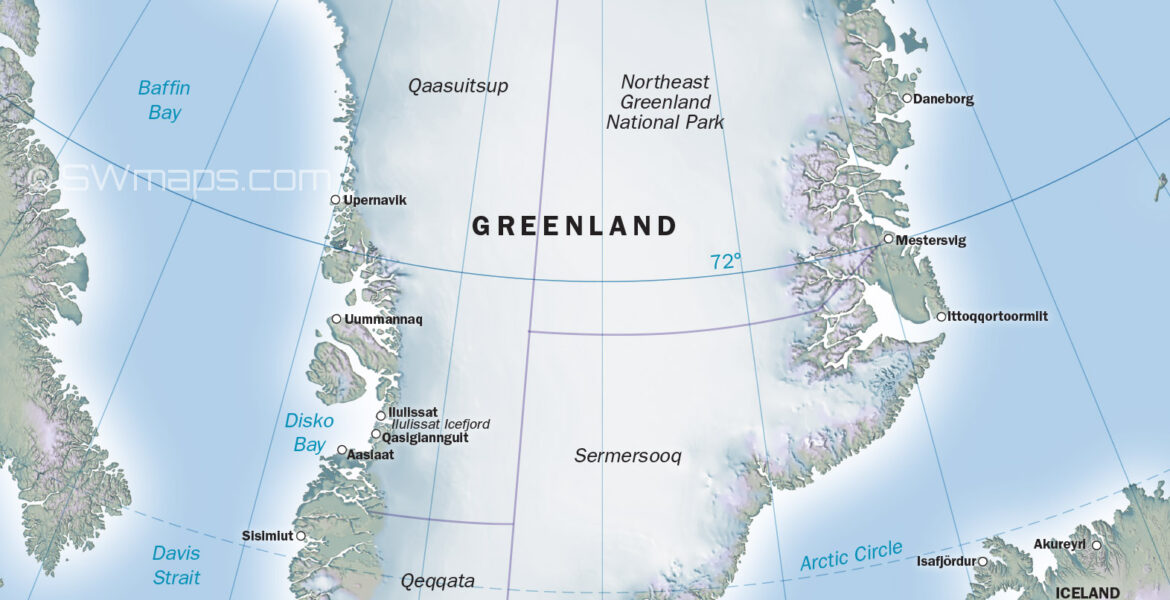
The Greenland map holds crucial importance in both geographical and political contexts. As the world’s largest island, Greenland is often overlooked in discussions of climate change, natural resources, and geopolitical dynamics. The Greenland map provides essential insights into its vast landscapes, ice sheets, and the location of its diverse communities.
Geographical Features and Layout
Greenland comprises approximately 2,166,086 square kilometres, with about 80% of its surface covered by the Greenland Ice Sheet. The map displays striking geographical features, such as its rugged mountains, deep fjords, and extensive glaciers. The capital city, Nuuk, is situated on the western coastline, surrounded by stunning natural scenery, which can be observed clearly on the map. Other key locations include the northern settlements of Qaanaaq and the southern town of Ilulissat, famous for its icefjord, a UNESCO World Heritage site.
Impact of Climate Change
As global temperatures rise, the Greenland map takes on new urgency. Satellite imagery and updated cartographic data reveal significant ice melt and changing coastlines. Studies show that the Greenland Ice Sheet is losing ice at an increasing rate, contributing to global sea-level rise. Mapping these changes is crucial for scientists monitoring the impacts on both local communities and the world at large.
Geopolitical Relevance
The geopolitical significance of Greenland is highlighted in recent discussions about the Arctic region. As melting ice opens new shipping routes and access to untapped resources, several nations are showing interest in the area. The map illustrates territorial claims and the maritime boundaries integral to understanding these geopolitical dynamics. Greenland’s association with Denmark adds complexity to international relations, especially regarding seabed rights and resource management.
Conclusion
The Greenland map serves as a vital tool for understanding the island’s topography, climate change effects, and geopolitical interests. It is not merely a geographical representation but a reflection of ongoing global issues, from environmental changes to international politics. As efforts to address climate challenges continue, the Greenland map will remain a key resource for researchers, policymakers, and individuals seeking to comprehend the dynamics at play in this critical region.
You may also like