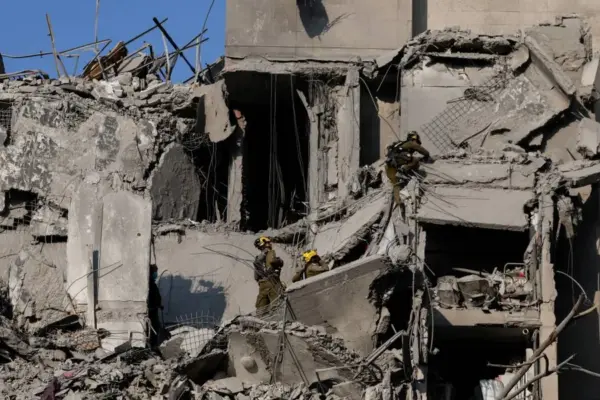
In a significant escalation of hostilities, Iranian ballistic missiles struck the Bazan Group refinery complex in Haifa, Israel, on March 7, causing extensive fires and power outages in the surrounding Krayot suburbs. This attack has raised alarms over Israel’s energy security, as Bazan is responsible for supplying 65% of the country’s diesel fuel, 59% of its gasoline, and 52% of its kerosene in 2024. The ramifications of this strike extend beyond immediate damage, threatening to disrupt the daily lives of countless residents and the broader economy.
The Iranian Revolutionary Guard Corps (IRGC) claimed responsibility for the missile attack, framing it as retaliation for recent US-Israeli strikes on an oil depot in Tehran. This tit-for-tat escalation underscores the fragile nature of regional stability, as both sides continue to exchange blows in a conflict that has already seen Iran fire a total of 300 missiles at Israel by the tenth day of the war. Nearly half of these missiles were equipped with cluster submunitions, creating multiple impact sites and complicating emergency response efforts.
Following the missile strike, fifteen firefighting teams were dispatched to the Bazan facilities to extinguish the fires and assess hazardous materials. Fortunately, no serious injuries were reported in the Haifa area, and Energy and Infrastructure Minister Eli Cohen stated, “The damage to the northern power grid was localized and not significant.” However, the extent of the damage to the Bazan refinery complex remains unclear, with reports indicating that the facility had already sustained damage to conduit piping from earlier Iranian attacks, necessitating the shutdown of some operations.
The missile used in the attack was equipped with a cluster warhead, which resulted in a ten-kilometer area affected by the munitions. Chaim Rafalowski, an expert in emergency management, noted, “Each missile creates numerous simultaneous emergencies rather than a single blast site,” emphasizing the challenges faced by first responders in such scenarios. While no hazardous substance leaks were detected, the potential for environmental and health risks remains a concern.
The immediate aftermath of the attack saw power outages reported in several areas of Haifa due to infrastructure damage. The strike has also had financial repercussions, with Bazan’s stock dropping by 6.5% and shares of Petrochemicals Ltd. falling by 10% following the missile strike. These developments highlight the interconnectedness of military actions and economic stability, as the impact of conflict reverberates through various sectors.
Reaction from the field
The Iranian state television reported that the strike targeted an energy facility in Haifa in retaliation for Israel’s strike a day earlier on Iranian gas facilities. This cycle of retaliation raises questions about the future of diplomatic efforts in the region, as both sides appear entrenched in their positions. Details remain unconfirmed regarding whether the reports of impacts in the Krayot suburbs referred to a direct missile hit or falling fragments from an interception.
As the situation continues to evolve, the implications of this missile strike extend beyond immediate physical damage. The ongoing conflict has the potential to reshape energy dynamics in the region, with Israel’s reliance on the Bazan refinery now under scrutiny. The international community watches closely, as the stakes grow higher and the humanitarian toll mounts amidst the backdrop of escalating violence.
You may also like