Image credit: Leon Neal/Getty Images
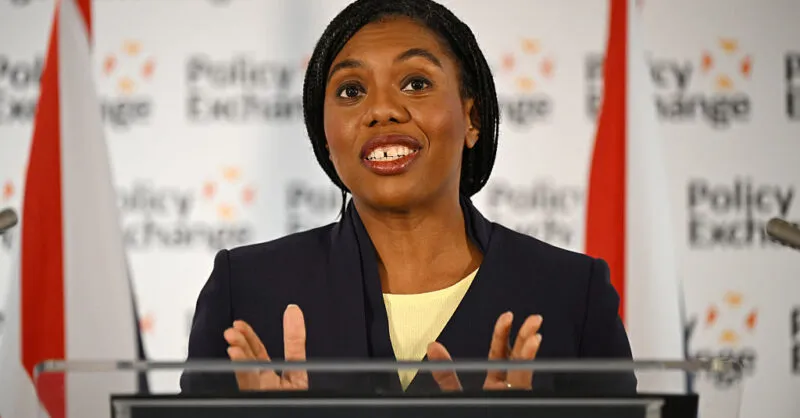
Kemi Badenoch has announced plans to “fundamentally” reform the Equality Act and create a new national narrative for schools to combat “separatism” in Britain. While the war in Iran is capturing attention, the Conservative leader delivered a speech today at the Policy Exchange think tank, asserting that “although Britain is a multiracial nation, we should not become a multicultural one” and emphasizing that “our country is our home, not a hotel.”
Reforming the Equality Act
Kemi Badenoch stated that if she were prime minister, she would possess “the bravery to establish boundaries” and eliminate what she termed “separatism”: communities in Britain that have not “integrated” or “assimilated.” According to Badenoch, the “true takeaway” from the Gorton and Denton by-election is that political parties are fostering this separatism through “campaigns aimed at mobilizing voters based on ethnicity and religion.”
To counter this trend, Badenoch has established a “Cultural and Integration Commission” that is expected to deliver a preliminary report prior to the Conservative Party conference in the fall. Badenoch’s team believes this topic plays to her strengths – that she is capable of articulating difficult truths and addressing controversial issues head-on.
The angle for this announcement became clear to Badenoch’s team after the Greens secured victory in the by-election, running a campaign that highlighted Labour’s stance on Gaza and included elements in Urdu. Following the Green win, Reform UK, who came in second, asserted that the outcome was invalid due to the fact that 10 percent of eligible voters in the constituency were born in Pakistan.
Combating Separatism in Britain
Join the New Statesman now for just £1 weekly. Sign up today!
However, the news cycle was dominated by the conflict between America and Israel and Iran. Rather than postponing her speech or settling for a less prominent position, Badenoch sought to connect the two topics.
She asserted that the “true reason” behind Keir Starmer’s reluctance to permit the US to utilize British bases for defensive actions in Iran stemmed from a concern about alienating “groups whose political affiliations regarding Middle Eastern conflicts do not correspond with British national interests.”
Multiracial vs Multicultural
In her complete statement, Badenoch remarked: “The stated reason for the reluctance is international law, but that is merely a cover. The true reason is not legal; it is political. Throughout the UK, there are factions whose political allegiances regarding Middle Eastern conflicts do not correspond with British national interests. These individuals are viewed by Labour as their constituents, as their support is crucial for retaining power. This situation is not about international law or principles; it is simply a political maneuver by a Labour Party that has forfeited its right to lead our nation, reflecting decades of unsuccessful integration policies.”
Sign up for our newsletters Explore all newsletters Receive the finest articles on politics and culture from the New Statesman directly in your inbox. Register here Enter your email address The Saturday Read Your weekly roundup of the most insightful writing on ideas, politics, literature, and culture every Saturday. The optimal way to subscribe to The Saturday Read is through saturdayread.substack.com Morning Call The New Statesman’s concise and vital overview of the day’s news and political landscape. The best method to enroll in Morning Call is via morningcall.substack.com Your email address First Name Last Name Subscribe Review our privacy policy for details on our services, how Progressive Media Investments may handle, process, and share your personal information, including your rights regarding your data and how to opt out of future marketing communications. THANK YOU Close
It came across as an overly clever analysis (or, to be a bit more critical, not clever at all). She suggested that Starmer had hesitated to support the United States due to concerns about the response from British Muslim voters, rather than out of a desire to ensure that any such action would comply with international law. If that were true, then why did Starmer declare that support in a speech from Downing Street on Sunday evening after receiving government legal advice indicating that the action would be lawful?
Establishing Community Boundaries
Her assertion that the Green Party’s victory indicated a prevailing socially conservative “Muslim vote” overlooked the reality that their backing extended well beyond the Muslim community, and that their candidate presented the most socially progressive platform of anyone in the race (a point also downplayed by the Prime Minister, who likened the Greens to George Galloway).
Any assertion that the Conservative Party’s by-election loss was due to an increase in sectarianism lacks credibility. Their candidate secured only 1.9 percent of the vote, which is merely a quarter of their anticipated result for the 2024 election in that constituency, marking the party’s lowest by-election performance ever recorded.
Kemi Badenoch also drew a distinction between the Conservatives and Labour as well as the Greens, asserting that while the latter focused on the foreign policy issues affecting various communities in Britain, which she argued fosters “separatism,” her party took a different approach. This perspective may surprise those residing in the Tory-held area of Harrow East. Its MP, Bob Blackman, who chairs the 1922 committee, has been vocal about the treatment of Hindus in Bangladesh, is linked to the Overseas Friends of the BJP organization, and previously participated in a UK4Modi car rally. Approximately 30 percent of his constituents identify as Hindu.
Isn’t this akin to the contrasting perspective of the Green campaign in Gorton and Denton, which shared an image of Starmer alongside Narendra Modi to appeal to voters who are critical of the BJP administration in India? Will Blackman face expulsion from the Conservative Party for “separatism”? This serves as yet another reminder of the age-old saying: being in opposition is challenging.
[Additional exploration: Is it possible for Keir Starmer to sidestep the errors made during the Iraq conflict?]
You may also like