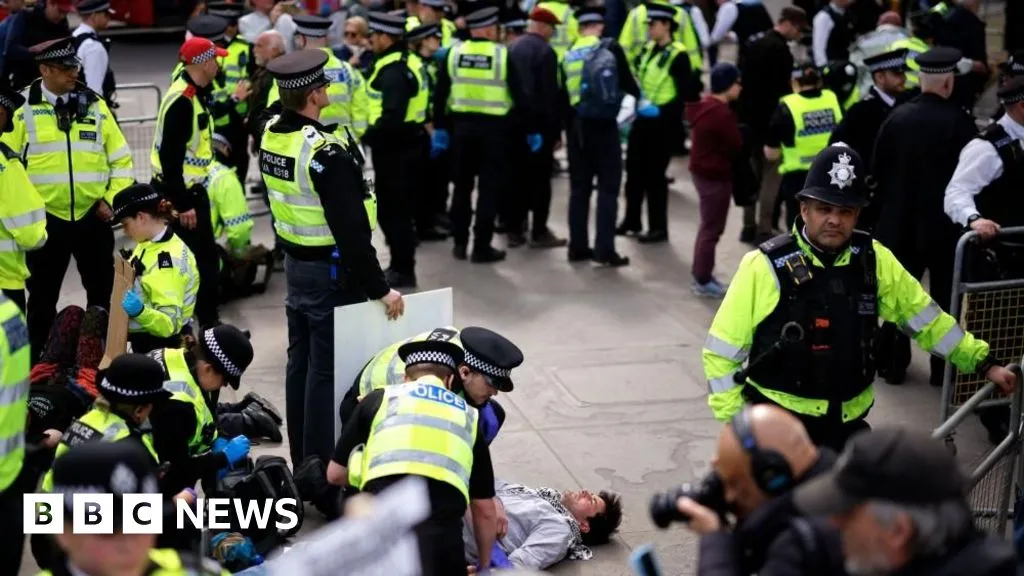
In the heart of London, a mass vigil held in Trafalgar Square on April 11, 2026, drew an estimated 1,500 participants, many of whom gathered to express solidarity with Palestine Action. This organization, which has been at the center of a heated debate regarding its classification as a terrorist group by the UK government, has seen its status challenged in recent months. Prior to this event, the atmosphere was charged with anticipation as the High Court had ruled the government’s proscription of Palestine Action unlawful just two months earlier, igniting hope among supporters for a shift in the narrative surrounding their activism.
However, the situation took a decisive turn when the Metropolitan Police arrested 212 individuals during the vigil. The ages of those detained ranged from 27 to 82, reflecting a diverse demographic united in their cause. This mass arrest starkly contrasted with the expectations of many who believed the court’s ruling would lead to a more open dialogue and less aggressive policing of protests. Instead, the police’s actions seemed to reinforce the fears of many demonstrators, who felt that their right to free speech was under siege.
Qesser Zuhrah, a prominent voice at the vigil, expressed the sentiments of many when he stated, “It just shows that the Met police, they don’t serve us, they don’t protect us, they work only to reinforce what the government wants.” This statement encapsulates the growing discontent among citizens who feel that their voices are being stifled by law enforcement in the name of governmental authority. The police’s response has not only affected those directly involved but has also reverberated throughout the community, raising questions about the balance between public order and civil liberties.
As the dust settled on the vigil, the implications of the police’s actions became increasingly apparent. The arrests were met with widespread condemnation from various quarters, including human rights advocates who argue that such heavy-handed tactics undermine democratic principles. An unnamed demonstrator poignantly remarked, “I think Britain has now descended into a non-democratic situation and I think that is very dangerous [for] free speech.” This sentiment reflects a growing concern that the government’s approach to dissent is evolving into a more authoritarian stance.
In a parallel development, Irish police have also ramped up enforcement against fuel-cost protesters, highlighting a broader trend of increased police action against civil disobedience across the region. The Commissioner of An Garda Siochana emphasized that illegal activities by fuel protesters are endangering the State, suggesting a unified front among law enforcement agencies in both the UK and Ireland against what they perceive as threats to public order.
As the UK government prepares to appeal the High Court’s ruling on Palestine Action on April 28 and 29, the stakes are high. The outcome of this appeal could have far-reaching consequences not only for Palestine Action but also for the future of protest movements in the UK. The government’s classification of Palestine Action alongside groups like al-Qaeda and Hezbollah has raised alarms about the potential for further crackdowns on dissenting voices.
In this climate of uncertainty, the actions of the police during the vigil serve as a stark reminder of the delicate balance between maintaining public safety and upholding the rights of individuals to express their beliefs. As communities grapple with these issues, the voices of those affected by the arrests will continue to resonate, urging a re-examination of the relationship between the state and its citizens in the pursuit of justice and free expression.
You may also like