Introduction
The magnetic north pole is a crucial aspect of navigational science and geography. As the reference point for compass readings, it impacts navigational systems globally. The position and movement of the magnetic north pole have significant implications for both maritime and aerial navigation, and its fluctuations are increasingly relevant as technology and travel expand.
Recent Changes and Developments
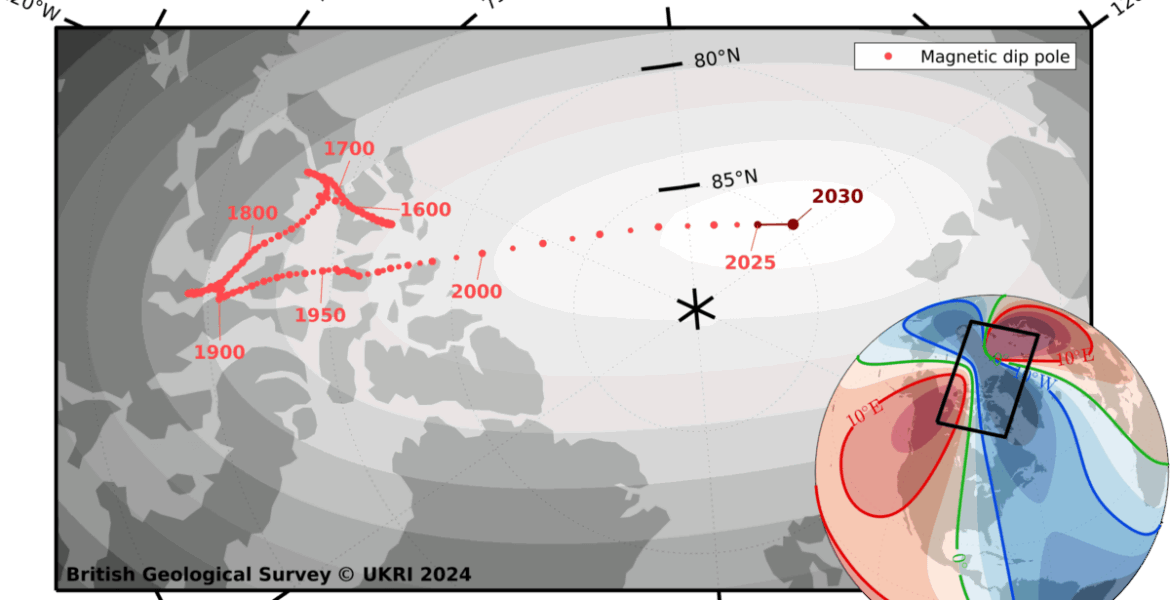
As of 2023, researchers have reported that the magnetic north pole is moving at an unprecedented rate, shifting from the Canadian Arctic towards Russia. Originally observed to move slowly at about 10 kilometers per year, recent studies suggest that this speed has increased to approximately 55 kilometers annually. This shift has raised concerns within the scientific community regarding its implications, especially for GPS systems and global navigation.
Geographical and Scientific Significance
The magnetic north pole is not a fixed point; it varies due to the fluid dynamics of Earth’s molten outer core. As the Earth’s magnetic field fluctuates, the magnetic north pole’s positioning changes. This is not just a curiosity for scientists; it plays a vital role in geophysical research and understanding Earth’s climatic changes. Moreover, the movement of the pole presents challenges for compasses and navigational systems, prompting updates to maps and navigational charts.
Impact on Navigation and Technology
In response to the shifting magnetic north pole, global navigation systems are gradually adapting. For instance, the World Magnetic Model (WMM), used by aids to navigation worldwide, is updated every five years to accommodate changes in the magnetic field. The latest update from 2020 reflects the rapid movement and the need for continuous monitoring of the magnetic north pole’s position.
Conclusion
Understanding the magnetic north pole is imperative for ensuring safe navigation in an increasingly interconnected world. As the pole continues to shift, scientists and navigators must remain vigilant and adaptable. The implications extend beyond mere navigation, touching upon broader environmental and geological changes. Consequently, the continued study of the magnetic north pole will be essential for both practical navigation and scientific inquiry, furthering our understanding of Earth’s complex systems.
You may also like